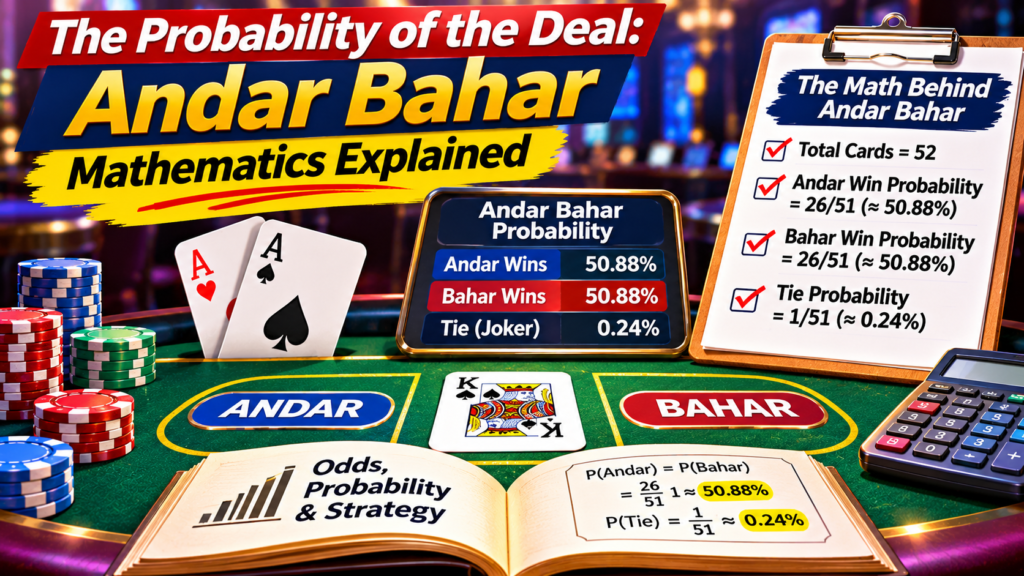
A game with two choices looks like a coin flip and is not quite one. The side receiving the first card after the joker holds a small structural advantage, the payouts are adjusted to reflect it, and the arithmetic behind both facts is simple enough to work through completely. Anyone playing Andar Bahar India tables can understand their exact position in about three minutes, which is unusual among casino games.
Why the Two Sides Are Not Equal
After the joker is revealed, cards are dealt alternately to the two piles, beginning with one specific side. That side receives the first card, the third, the fifth, and so on. Because the round ends as soon as a matching card appears, the side dealt first has slightly more chances to receive it. The asymmetry is small but real, and it is the entire reason the two bets carry different payouts.
Where the Numbers Come From
The calculation is a counting exercise.
Three Matching Cards in Fifty-One
After the joker is drawn, fifty-one cards remain, three of which match its rank. The probability that the first dealt card matches is three in fifty-one. If it does not, the probability shifts for the second position, and so on down the deal. Summing the odd positions gives the first side’s total probability and the even positions give the other’s. The standard published result places the first side slightly above fifty percent, which is why its payout is reduced accordingly.
How Payouts Compensate
Pricing follows the asymmetry:
- The advantaged side typically pays slightly less than even money
- The other side pays even money or marginally better
- Both figures sit below fair odds, producing the house edge
- The edge on the two main bets is usually close to identical
- Side bets carry substantially higher edges, as in most card games
Because the main bets are priced to near-equal edges, choosing a side is a stylistic rather than a strategic decision, which is worth knowing before adopting any system based on picking one.
What No Strategy Can Change
Nothing in the game permits influence after staking. The deal proceeds mechanically, the player makes no further decisions, and no sequence of previous rounds affects the next, since each begins with a shuffled deck. Systems promising improvement through tracking previous results are reading pattern into independence, and the mathematics above explains precisely why there is nothing to track.
A Game That Shows Its Work
The rare virtue here is complete transparency: the deck composition is known, the deal order is published, the probabilities are calculable with arithmetic, and the payouts are stated. Few casino games permit a player to derive their exact expected return from first principles in a few minutes. This one does, which makes it an unusually honest place to learn what a house edge actually is.